Local B2B service
Welding services for Sheffield businesses
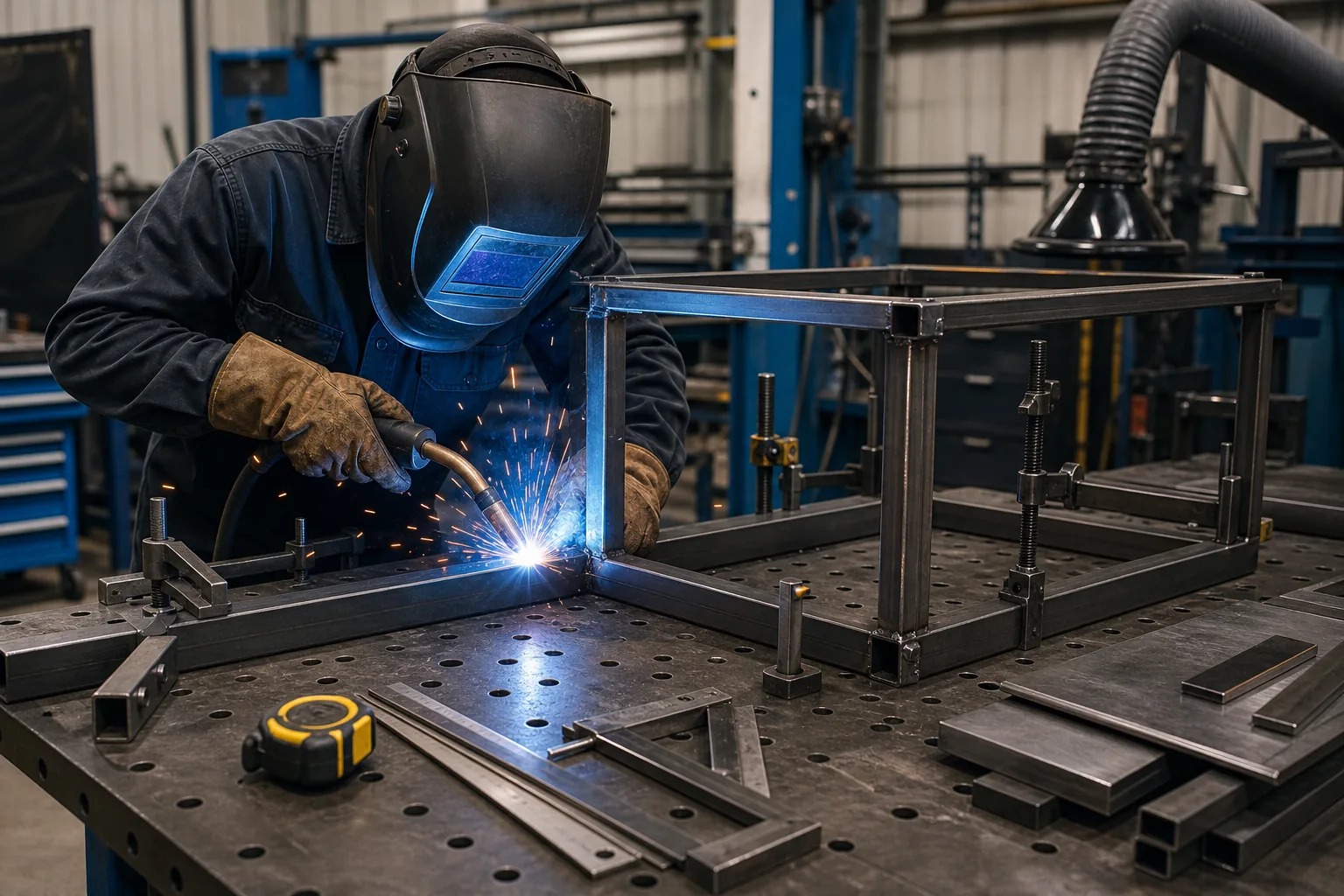
Welding is central to repairs, fabricated equipment, pipework, frames and production assemblies, but a sound result depends on matching the process and preparation to the real duty. Subcontract Engineering Services supports Sheffield B2B customers that need a welding requirement reviewed in the context of material, joint design, access, quantity, finish and timescale. That may be a single repair item, an overflow batch or welding within a wider fabrication package.
MIG/MAG, TIG and manual metal arc processes each have useful applications, yet the process name alone does not define the job. Material grade and thickness, joint type, position, heat input, distortion risk, penetration, appearance and any code or procedure requirement should be considered. State if the work is safety-critical, pressure-retaining, structural or subject to specified welder qualifications, inspection or traceability so those requirements can be reviewed before quotation.
Many Sheffield buyers need a completed assembly rather than welding labour in isolation. Profiles may require laser or plasma cutting, parts may need machining before or after welding, and the finished item may require dressing, testing or coating. Supplying the assembly context allows the sequence to be planned and reduces the chance of a critical surface being distorted, obscured or finished too early.
What the service can cover
- Welded steel frames, brackets, supports, guards, repairs and general engineering assemblies.
- Review of MIG/MAG, TIG or MMA process suitability according to the stated requirement.
- One-off parts, maintenance work, project batches and repeat production assemblies.
- Integration with sheet-metal work, steel fabrication, machining, pipework and finishing.
- Drawing, weld-symbol, inspection and documentation requirements captured at enquiry.
- Workshop-led and potential site-led project discussions for Sheffield business customers.
Technical points to define before ordering
Joint design and preparation
A weld can only perform as intended when the joint, fit-up and access are appropriate. Parent material, thickness, bevel, root condition, gap, backing, tack arrangement and welding position all affect the route. Drawings should communicate whether a weld is continuous or intermittent, its size and location, and any areas that must remain free from spatter or distortion. Where a formal welding standard applies, provide it explicitly.
Controlling distortion and dimensions
Heating and cooling create shrinkage, so an assembly may need sequencing, balanced welding, restraint or post-weld machining. Critical mounting faces and hole patterns should be identified separately from general fabrication dimensions. On repeat work, a suitable fixture may improve consistency, but its cost needs to be considered against batch size and future demand. Sharing forecast quantities helps choose a proportionate approach.
Inspection, finish and records
Visual inspection may be sufficient for general non-critical work, while other duties can require dimensional reports, penetrant, magnetic particle, ultrasonic or radiographic examination, procedure records, welder qualifications or material traceability. These provisions are not automatic and must be agreed. Similarly, dressing a weld flush changes time and potentially section, so drawings should state where the as-welded profile is acceptable and where a blended cosmetic finish is necessary.
Typical welding applications
The following examples show the kind of commercial requirement that may be discussed. They are not a guarantee that every size, material, certification or deadline is available; the actual job is confirmed after technical review.
- equipment frames and stands.
- guards, panels and brackets.
- repair and modification work.
- welded production assemblies.
- pipe and support fabrications.
- maintenance shutdown requirements.